Why Your Body Still Remembers — The Neuroscience of Somatic Trauma
You've told yourself you've moved on — but your tight shoulders and unexplained anxiety tell a different story. Discover why your body still keeps score.
You may have had this experience before.
You are not thinking about the past. You are not in the middle of anything dramatic. You may simply be reading a message, walking into a familiar room, hearing a certain tone of voice, or sitting with someone you care about.
And then your body reacts before you have had time to explain it.
Your shoulders lift. Your chest gets tight. Your stomach drops. You want to leave, defend yourself, make everyone happy, or disappear for a little while.
Later, you may wonder why such a small moment affected you so much.
“I thought I was over this.”
“I know nothing terrible is happening right now.”
“So why does my body still feel like it has to prepare?”
If you have ever asked yourself that question, I want to begin here: your reaction does not mean you are broken, dramatic, or failing at healing. It may simply mean that something about this moment feels familiar to a part of you that learned to stay alert.
Your body is not keeping a secret from you
People often use the phrase “the body keeps the score.” It can be a meaningful way of describing the gap between what we know and what we feel.
But I do not think it helps to imagine trauma as something literally stored inside your muscles or hidden in your cells, waiting for you to dig it out. Your body is not a locked room full of memories you have to force open.
A gentler way to understand the experience is this: our brains and bodies learn from what happens to us.
If a certain kind of relationship, voice, situation, or uncertainty once came with criticism, fear, shame, or the feeling that you had no choice, your system may become quick to notice anything that resembles it. A cue can be small, but the response can be large because it is connected to more than this one moment.
That response is real. The feeling in your chest is real. The urge to leave is real.
But a body feeling alarmed is not always the same as a body being in danger now.
The phone call that could take over my whole day
There was a time when I had a tense relationship with an older family member I cared about deeply.
Whenever their name appeared on my phone, my whole body would tighten before I even answered. I could feel it in my shoulders and chest. And the anxiety did not end when the call did. Once we had arranged to meet, it stayed with me until the meeting was over.
I would worry about what they might say, because being around them often meant hearing what I had not done well enough, or how I should be doing things differently. Those comments were often framed as being for my own good. I know they may have believed they were trying to help. But the effect on me was pressure.
From the moment I saw their name on my screen, it became difficult to focus on anything else. I felt tense, low, and unable to do my work properly. My mind kept returning to the upcoming meeting as if it were something I had to prepare myself to survive.
For a long time, I treated my reaction as a flaw. I told myself I should be more understanding. I cared about this person. I knew they had their own worries. So I thought the problem must be that I was too sensitive.
But eventually I understood something that changed how I spoke to myself. I did not have to decide whether they were a good person or a bad person in order to take my own reaction seriously.
My body had learned that these interactions often came with criticism and the possibility of feeling small. It was trying to prepare me in the only way it knew how.
That did not make every fear a fact. It did not mean I had to obey every alarm. But it did mean I could stop calling myself ridiculous for having one.
Why understanding is sometimes not enough
You can understand a relationship clearly and still feel tense inside it.
You can know that you are an adult now, that you have choices now, that you do not have to accept every criticism — and still notice that your body braces when the familiar pattern begins.
This is not proof that thinking, therapy, or self-awareness do not help. They can help a great deal. It is simply a reminder that insight often needs time to become something you can feel in the moment.
For some people, that learning happens through a therapist, through a safer relationship, through practising a boundary, through sleep and routine, through grief that is finally allowed to be grief, or through the quiet experience of discovering: “I had a choice, and I used it.”
The body does not need to be forced into a new story. It may need repeated experiences of being met with more care, context, and choice than it had before.
When a small cue feels much bigger than the moment
A raised voice. A message left unanswered. A certain look on someone’s face. An upcoming appointment. A smell, a song, a season, a street you used to walk down.
None of these things have to be dramatic in order to affect you.
Sometimes the hardest reactions come from small cues precisely because they are familiar. Your mind may say, “This is only a message.” Your body may say, “I remember what messages like this have meant before.”
That does not mean you need to hunt for one perfect origin story every time you feel anxious. In fact, when you are already overwhelmed, trying to find the deepest explanation can make you feel even more trapped.
A more helpful question can be:
What would help me have a little more choice in this moment?
Maybe it is looking around the room before you reply. Maybe it is putting your feet on the floor. Maybe it is deciding you do not have to answer immediately. Maybe it is texting someone you trust. Maybe it is reminding yourself that another person’s disappointment does not automatically mean you have done something wrong.
Small things are not silly when they give you back a little space.
You do not have to force your body to calm down
There is a lot of advice online that tells people to “release” what is stuck in the body, breathe deeply until they feel safe, scan every tense muscle, or go searching for a buried wound.
Some people find body-based practices helpful. Others find them too intense, especially when they already feel panicked or disconnected.
You do not have to force yourself through a practice simply because it works for someone else.
If closing your eyes makes you feel less present, keep them open. If focusing on your breath makes you more anxious, let your breathing be ordinary and notice something outside of you instead. If a body scan makes you feel flooded, start with the chair under your back or the floor beneath your feet.
The goal is not to become perfectly calm. It is to have a little more room to choose your next step.
A gentle place to begin
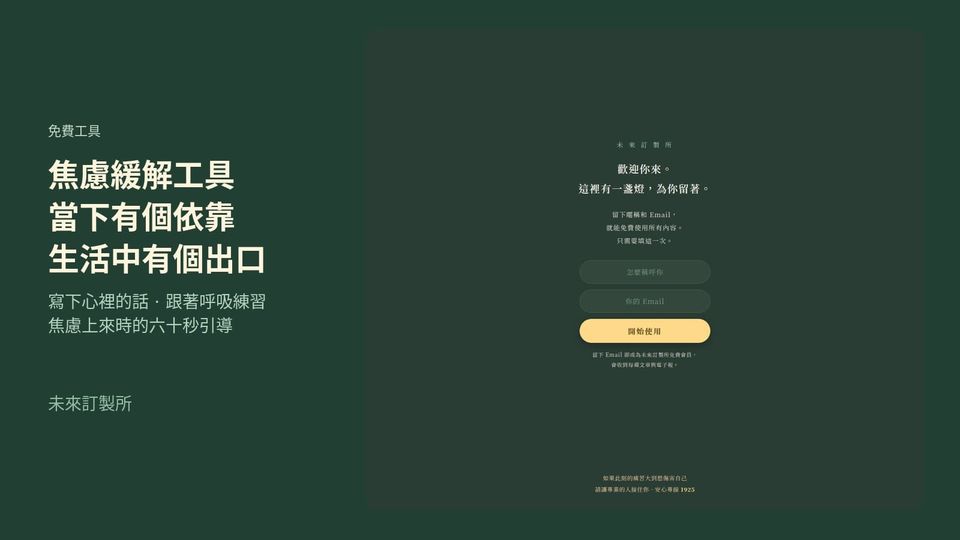
If you need something immediate when your body feels on high alert, you can try my Free Anxiety Relief App. It is free to use; on first use, it asks for your email to create a free Future Healing Design membership, and you can unsubscribe from future emails at any time.
Your body is not your enemy
The body is not trying to ruin your life when it becomes tense, alert, tired, numb, or ready to run.
It may be trying to protect you with information that made sense once, even if it does not fit every situation now.
You do not have to shame it into silence. You do not have to treat every reaction as proof that something terrible is about to happen. And you do not have to solve your whole history before you are allowed to feel better.
You can begin by meeting yourself where you are.
“I notice I am bracing.”
“I do not know exactly why this feels so big.”
“I do know that I am here now.”
“I have more than one option.”
Sometimes healing begins there: not when the body finally stops reacting, but when you stop abandoning yourself because it did.
When you may need more support
This article is for gentle understanding and self-support. It is not a diagnosis or a replacement for mental-health care.
If body sensations bring up flashbacks, intense panic, dissociation, thoughts of harming yourself, or a feeling that you are no longer in the present, you do not need to push through alone. Stop any exercise that makes things worse, orient to the room, contact someone you trust if you can, and consider speaking with a qualified mental-health professional.
If symptoms are persistent, disrupt sleep or work, lead you to avoid parts of life, or make it hard to care for yourself, you deserve support that is made for what you are carrying.[1]
Reference
[1] National Institute of Mental Health. Post-Traumatic Stress Disorder.
如果你現在不是想理解原因,而是身體已經先緊起來了:可以接著讀 When Your Body Is Still on High Alert: 5 Gentle Ways to Come Back to the Present。它不要求你挖出每一個過去,只提供幾個溫和、可以隨時停下的回到當下方法。