How Wallo267 Turned 20 Years in Prison into a Masterclass in Manifestation and Forgiveness
Wallo267 transformed 20 years in prison into a masterclass on life. He shows us how to turn cages into classrooms, manifest from nothing, and why forgiveness is about breathing. His story is a blueprint for radical inner freedom.
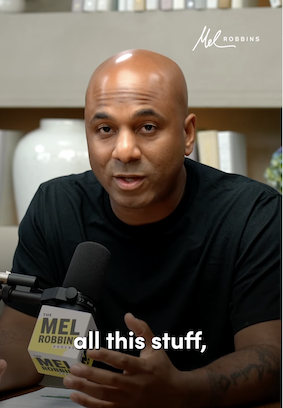
"Forgiveness for me personally, it helps me breathe." — The pivotal conversation between Wallo267 and Mel Robbins.Have You Heard the Name Wallo267?
If you’ve seen him on social media, you might think he’s just another energetic, loud, wealthy Black influencer. But today, I want to tell you the legendary and heart-wrenching real story behind him—a story that isn’t just about motivation, but the ultimate lesson in how to rewrite your life script from the rock bottom.
Wallo was born in Philadelphia, USA. As a young man, like many lost youths, he got involved in street crime. At 17, in what should have been the most blossoming years of his life, he was arrested for armed robbery.
The judge sentenced him to 20 years.
What does 20 years mean? It means the world would be completely different when he walked out. For most people, that would be the end, a sentence of utter despair.
While most of us haven’t made mistakes that severe, we’ve all had our own moments of “failure” in life. Choosing the wrong major, loving the wrong person, making a poor decision… and then feeling like our life is “ruined,” as if sentenced to an invisible prison of regret and powerlessness.
But what did Wallo do? During those 20 years behind bars, he did something that should humble all of us who are free. He demonstrated that true freedom begins in the mind.
Act I: The Cell Was Not a Limit, But a Training Ground — The Miracle of a Shift in Perspective
Wallo didn’t let time slip away. In prison, while his body was confined, he realized his mind was free. He began to read voraciously—business, marketing, brand-building, psychology. Even without internet access, he devoured outdated business magazines and keenly sensed the massive shifts happening outside (the rise of social media, the influencer economy).
He is famous for saying:
“I always tell people, ‘I wasn’t in jail, I was in Yale. I wasn’t in prison, I was in Princeton. I wasn’t in the state pen, I was in Penn State.’”
He turned punishment into postgraduate study.
This makes me reflect on how we, as free people, are constantly sentencing ourselves. We say, “I’m too old to start,” “I don’t have enough resources,” or “That’s just how I am.” These limiting beliefs are the invisible prisons we build for ourselves. Wallo’s lesson is this: The nature of your circumstance depends on the label you give it. Do you define it as a “cage that punishes me” or a “training ground that strengthens me”? This shift in perspective is the first step in manifesting any possibility.
Act II: The Pinnacle of Manifestation — ‘Being’ It Before ‘Having’ It
In 2017, Wallo was finally released at age 37. He had missed the invention of the iPhone and leaps in technology, but he wasn’t out of touch. Using the knowledge and personal brand strategy he cultivated in prison, he quickly blew up on Instagram and later co-founded a multi-million dollar podcast with his cousin.
How did he do it? In a recent interview with renowned author Mel Robbins, this conversation touched countless hearts. Mel Robbins is a world-renowned speaker and author of “The 5 Second Rule,” known for exploring how to overcome internal barriers and take action. She asked Wallo a question that went straight to the core:
Mel Robbins: You talk about practicing living the life you wanted before you got out. That description is incredible.
Wallo: Yeah, when I got out, I had no money, but I would go to the Four Seasons in downtown Philly and order a hot tea, pretending I owned it all. I’d go look at luxury apartments and ask, ‘Is this wall good for my painting?’ I’d test drive the most expensive cars, connect my Bluetooth, play my theme song, hand out the window like it was my car…
Mel Robbins: That’s visualization. You weren’t just seeing it; you were engaging all your senses—sight, sound, touch—to experience that scene, making your brain believe it was real.
Wallo: Exactly. I told myself, no one can stop me but me. You are your own worst enemy.
This dialogue is the pure practice of the law of manifestation. He didn’t wait to be wealthy to experience abundance; he aligned his “frequency” with abundance while having nothing. This isn’t self-deception; it’s the deepest form of self-programming. His body was in prison, but his emotions, his senses, his identity were already living in the future he chose. We often focus only on “having” something, skipping the crucial step of “being” the person who has it. Wallo teaches us: Manifestation isn’t wishful thinking; it’s using all your senses to “rehearse” your desired state in advance. Today, what one small “dress rehearsal” can you do for the state you desire? Is it wearing clothes that make you feel confident to work? Or creating a corner of peace in your home that matches the calm you crave?
Act III: The Most Difficult Manifestation — Forgiveness as Making Space for Your Own Heart
But what I admire most about Wallo isn’t his wealth, but his mindset. Shortly after his release and success, tragedy struck. His younger brother was killed in street violence. Facing his brother’s killer, where most would choose revenge, Wallo chose to advocate for peace and an end to the killing.
Mel asked him a question that went straight to the core:
Mel Robbins: “Let’s talk about forgiveness. Your brother was killed. How did you forgive the person who did it?”
Wallo’s answer, without a hint of hesitation, became the most profound definition of “forgiveness” I’ve ever heard:
“Forgiveness for me personally, it helps me breathe. Because the hatred and the anger is so heavy, you can’t move forward with it. I didn’t want that dark part to take over the memory of my brother.”
I’ve often pondered this myself. While our wounds may not be as heavy as losing a loved one to violence, perhaps we’ve been betrayed by someone we deeply loved, deceived by a trusted friend, or subjected to long-term unfair treatment. To speak of “forgiveness” feels incredibly difficult. Sometimes we even feel that forgiving would be a betrayal to our wounded self.
But Wallo reminds us: Forgiveness isn’t for the other person; it’s for you. Hatred, anger, and resentment are extremely low-frequency energies. They are like a massive stone on your chest, occupying space in your heart. If you carry that stone, how can you run swiftly? How can you have space to welcome new, beautiful things? If your energy field is constantly pulled back by old stories, how can you manifest a brand new future?
So, if forgiveness feels impossible, at least try to “let go.”
Tell yourself: “This pain, I acknowledge it exists. But for my own breath, for my path forward, I choose not to let it dictate my present and future anymore.” This isn’t about forgetting; it’s consciously reclaiming your energy from the “past story” and investing it into the “blueprint of your future.”
This is what we always talk about—to manifest, you must heal. If you don’t heal, if you don’t clear out the heavy debris within, it’s very hard to manifest the lightness you seek. Healing is about clearing a clean stage for your new story.
What Are You Manifesting?
Wallo’s 20 years of incarceration and life’s hardships show us: No matter how low your starting point, no matter what wounds you carry, if you are willing to shift your perspective, willing to become in advance, and willing to lay down your burdens, you can restart your life at any moment. This trilogy is the awakening path of inner strength.
Honestly, if you’ve been reading my articles, have you noticed it too? We are manifesting all the time. Every thought, every complaint, every uttered “I can’t,” every tiny moment of gratitude—it’s all an order placed with the universe. The question is, what are we unconsciously manifesting? A self that constantly complains? Or a heart moved by small wonders? A mindset that blames fate at every setback? Or an awareness that seeks the gift within the hardship?
“Manifestation” is just a word that helps us understand this creative force. In truth, everything lies in our thoughts and feelings. How you think and feel guides how you act, ultimately shaping the contours of your life. All we need to do is consciously steer everything toward the loop we truly desire.
Wallo’s story is a mirror. Look into this mirror and gently ask yourself: “At this very moment, what am I building for myself—a cage, or a school? What future am I rehearsing? Does my heart have space for new things to enter?”
Your answer is the starting point for your next chapter.
BONUS READS:
https://www.futurehealingdesign.com/emotional-regulation-neuroscience-sky-metaphor/